
When Should Kids Start Swimming Lessons in Singapore?
13 October 2026 · 7 min read
Babies can start parent-and-baby classes from about 4 months. Lessons start to build real water skills from age 1, most children are ready to swim without you between 3.5 and 4, and strokes follow from 5. School SwimSafer arrives in Primary 3, and a child who can already swim gets more out of it. Our pick for a first lesson is SWISH! Swimming at Dempsey Hill: temperature-controlled pools, classes grouped by age from 4 months, and no more than five children a class. Book a SWISH! trial on Jungle.
Most swim schools in Singapore will take your baby at 4 months. Primary school teaches SwimSafer in Primary 3, at about 9. In between sits an eight-year window, and the question every parent asks: when should kids start swimming lessons?
There is no single right age. There are four stages, and each asks something different of your child, and of you. A 6-month-old learns to love the water. A 4-year-old learns to swim without holding your hand. A 7-year-old learns strokes.
This guide covers what a lesson looks like at each stage, the signs your child is ready, condo pool or swim school, and what to check before you pay. Every fact was checked on the school's or the agency's own site on 13 October 2026.
This guide is written in partnership with SWISH! Swimming, our pick for a first lesson.
The Short Answer, Age by Age
The ages are a guide, not a deadline. A child who starts at 6 or 7 is not behind. They simply start at stage four.
Stage 1: 4 to 12 Months, Water Play With You
This stage is about joy, not safety skills. A baby class is 30 minutes of songs, splashing, supported floats, blowing bubbles and first dips under the water on a cue word. You are in the pool the whole time, holding your baby.
The American Academy of Pediatrics (AAP) says there is no evidence that lessons before age 1 lower drowning risk. That is no reason to skip them. It is a reason to choose them for what they do give: a baby who is relaxed in the water, and half an hour a week of your full attention.
Two things matter at this age. Warm water: the AAP suggests about 31 to 34°C for children aged 3 and under. And a go-ahead from your paediatrician, which SWISH! says most babies get at around 4 months.
Ready when: your baby holds their head steady and your paediatrician says yes.
SWISH! Swimming, Dempsey Hill
SWISH! groups its Mini Fini classes by age: 4 to 9 months, 9 to 18 months, 18 to 24 months and 24 to 42 months. Your baby is never the smallest in a room of toddlers. Each class is 30 minutes for up to five babies, each with a parent in the water, and covers safe entry, water on the face, bubbles and supported floats. All three pools on Loewen Road are temperature-controlled, and the coaches are AUSTSWIM-certified.
Price: $40 a weekday class or $46 at weekends, before 9% GST ($43.60 and $50.14 with it). One make-up token a month.
Trial: The same price as a class. If you enrol, it becomes your first lesson.
Book on Jungle: SWISH! Swimming
Stage 2: 1 to 3 Years, Lessons Start to Count
From age 1, lessons start to build real skills. The AAP now says swim lessons can begin for many children at 1, as "a layer of protection" around water.
Toddler classes add the skills that matter around a pool: jumping in to you, turning back to the wall, holding on and climbing out. You still get in. Most schools keep a parent in the water until 3 or later, and SWISH! keeps you in until 3.5.
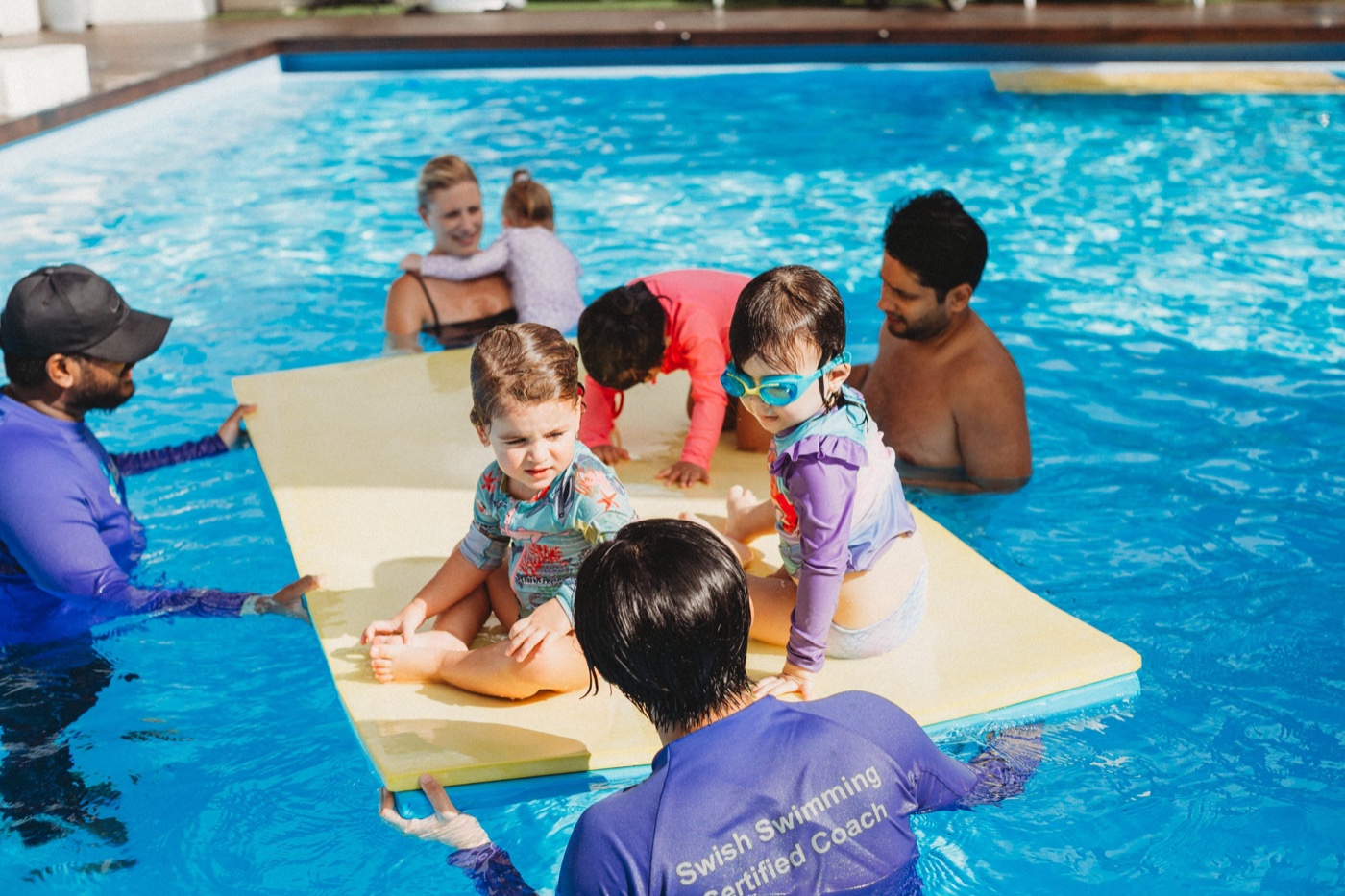
Toddlers and parents in a SWISH! Mini Fini class. Photo: SWISH! Swimming
Toddlers also bring opinions. A 2-year-old who cried last week may laugh this week. The same day, the same pool and the same coach help more than an extra class.
Ready when: they enjoy bath time, and you can commit to one class a week for a term.
To compare 18 schools that teach this age, read our guide to swimming lessons for babies and toddlers.
Stage 3: 3.5 to 4 Years, Swimming Without You
This is the big step. Between 3 and 4, most schools move children into classes without a parent. The AAP says that by their fourth birthday, most children are ready for lessons if they have not already started.
Now the coach is in charge. A beginner class works on breath control, floating, kicking and moving through the water with a long, straight body. A child who already likes water on their face has one less thing to learn.
Ready when: they can follow a coach for 30 minutes, put their face in the water and wave you goodbye at the poolside. If the goodbye is the hard part, a class built for nervous children helps.
SWISH! Learn-to-Swim, from 3.5
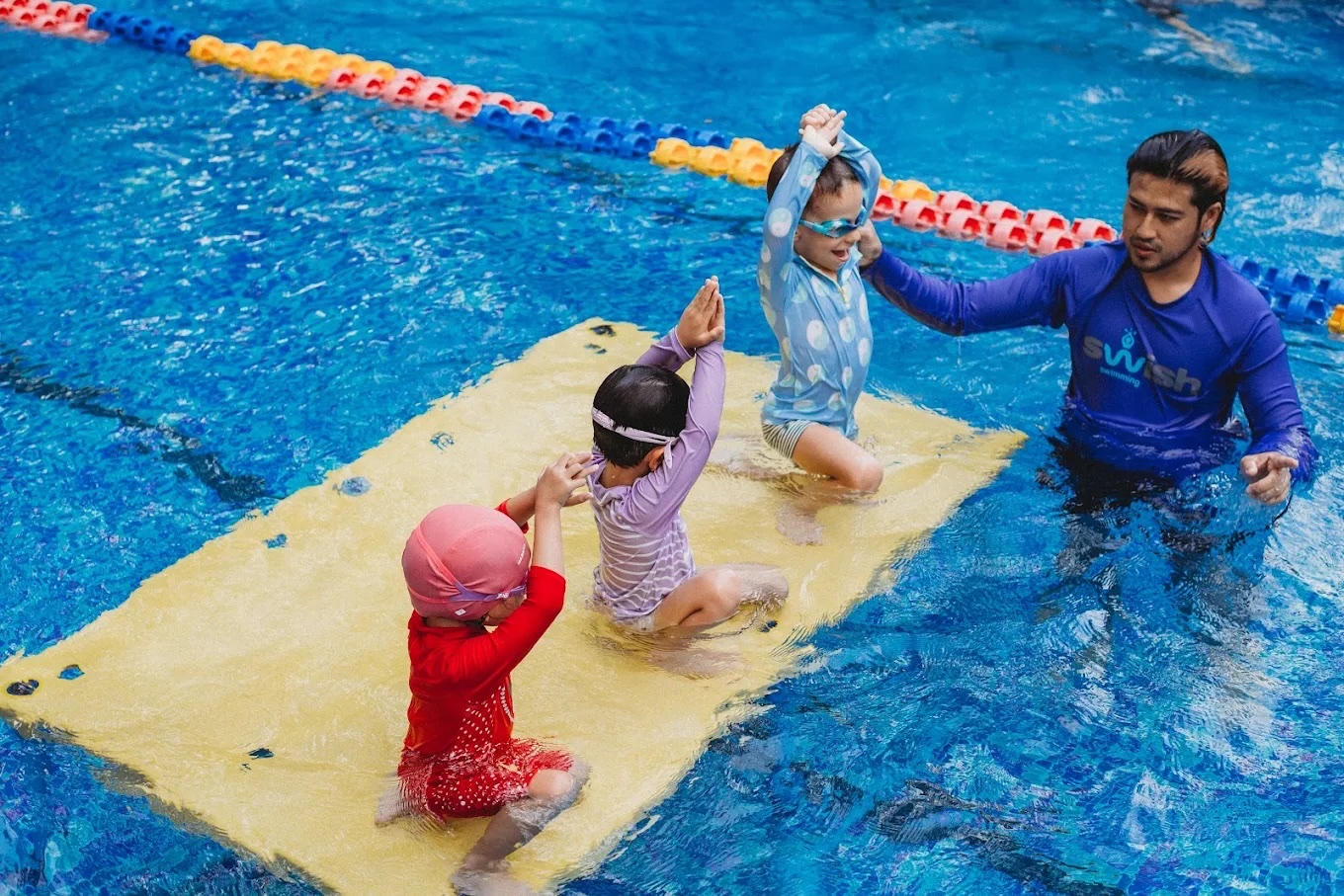
A SWISH! coach with three young swimmers. Photo: SWISH! Swimming
At 3.5, SWISH! children move up to Zuma Beginner 1: four children to one coach for 30 minutes, working on confidence, breath control, movement and balance. They progress through Beginner 2 and Paddler to Rainbow, from 4, where freestyle and backstroke arms come in. Coaches move children up on ability and understanding of water safety, not on a timetable. For a child who is scared of the water, Stressless is a play-based class at their own pace.
Price: $40 a weekday class or $46 at weekends, before 9% GST.
Trial: A normal class with a level check. Bring a swimsuit, towel, goggles, a cap for long hair and a bottle of water.
Book on Jungle: SWISH! Swimming
Stage 4: 5 and Up, Strokes and SwimSafer
From 5, children learn to swim properly. Freestyle with side breathing, backstroke, breaststroke and longer distances. At SWISH!, side breathing comes in Zuma Roller at 6 to 7, and all four strokes, butterfly included, in Zuma Stroker from 7.
This is also when SwimSafer comes into view. SwimSafer 2.0 is the national water-safety programme: six stages of about 12 hours each. Stage 2 asks for 25 metres of continuous swimming, and Stage 3 for 50. Primary schools usually enrol the whole Primary 3 cohort, in curriculum time, fully funded by MOE.
School lessons are a good start, not a finish line. In 2019, 83% of pupils met Stage 1, 55% met Stage 2 and 39% met Stage 3, according to MOE. A child who can already swim turns those hours into practice, and into fun.
Starting at 5, 6 or 7 is not late. An older beginner can follow a coach from the first lesson, which is most of what a beginner class asks.
Is Your Child Ready? A Quick Check
- They are happy with water on their face. If not yet, pour a cup of water over their head at bath time and make it a game.
- They can follow a simple instruction from an adult who is not you. If not yet, a class with you in the water bridges the gap.
- They can stay with one activity for 30 minutes, the length of most baby and beginner classes.
- For babies: a steady head and a yes from your paediatrician.
- You can keep the same slot every week for a term. Progress comes from repetition.
A trial class tells you more than any checklist. At SWISH!, the trial is a normal class at the normal price, with a level check, and it becomes your first lesson if you enrol.
Condo Pool or Swim School?
Both work. They suit different children at different ages.
| Condo pool | Swim school | |
|---|---|---|
| Getting there | Downstairs | A weekly trip |
| Water | Whatever the weather gives you | Often heated |
| Class | Private, or a few neighbours | A small group the same age |
| A lesson costs | $31.88 to $120 | $37.25 to $70.85 in a heated pool |
| Best for | Confident swimmers, 5 and up | Babies, toddlers and first-timers |
A condo coach is hard to beat for a confident 6-year-old working on strokes: no travel, often one to one. For a baby or a nervous first-timer, warm water and a class built for their age matter more than the walk downstairs.
One thing applies everywhere: outdoor pools stop for lightning, so ask what happens to a missed class. At SWISH!, a lightning alert means a make-up.
What to Look For in a Swim School
- Certified coaches. Ask which certification. SWISH!'s coaches hold AUSTSWIM, Australia's national swim-teaching qualification.
- Warm water for under-3s. About 31 to 34°C, says the AAP.
- Small classes grouped by age. A 6-month-old and a 3-year-old need different lessons.
- Water skills before strokes. Floating, turning back to the wall and climbing out come first.
- A lifeguard on duty while lessons run, as the AAP recommends.
- A way to try first. Watch a class or book a trial, and ask how make-ups work.
Three Things Parents Hear
"Babies are born swimmers." Babies kick and paddle by reflex, but they cannot lift their heads to breathe. Baby classes build comfort, which is worth having for its own sake.
"The earlier, the better." Starting at 4 months does not mean swimming by 2. It means a child who feels at home in the water when the real lessons start.
"My child is too scared to start." Fear is a reason to pick the right class, not to wait. Small groups, warm water and a patient coach do more than another year on the poolside.
Quick Answers
Can a 6-month-old take swimming lessons?
Yes. Parent-and-baby classes take babies from about 4 months, with you in the water. Check with your paediatrician first, especially if your baby was born early.
Is 7 too late to learn to swim?
No. Seven is a good age to start. Many children first swim properly in SwimSafer in Primary 3, and a 7-year-old can follow a coach for a full class.
Do I have to get in the water?
For babies and toddlers, yes. Most schools keep a parent in the pool until 3 to 4. At SWISH!, a parent swims with every child up to 3.5, unless you book a private class.
Is school SwimSafer enough?
It is a good start. Schools give the Primary 3 cohort SwimSafer lessons funded by MOE, and in 2019, 55% of pupils reached Stage 2, which asks for 25 metres of continuous swimming. Lessons before Primary 3 mean your child arrives ready to get more from them.
Ready for the First Lesson?
Pick the stage your child is at, then book a class that fits it. For a first lesson, book a SWISH! Swimming trial on Jungle. To compare more schools, read our babies and toddlers guide or our 2026 parent guide to swimming lessons, or browse swimming lessons on Jungle.
Blogs
Oct 20, 2026
What Taekwondo and Martial Arts Classes Cost in Singapore (2026)
Oct 20, 2026
What Ballet Classes Cost in Singapore (2026): Fees, Exams and Extras
Oct 16, 2026
Classes for 4 Year Olds in Singapore: 10 Activities, 181 Schools (2026)
Oct 16, 2026
Hip Hop and Creative Dance for 3 to 5 Year Olds in Singapore: 20 Schools (2026)
Oct 16, 2026
Swimming Lessons for 4, 5 and 6 Year Olds in Singapore: 26 Schools (2026)
The Friday edit.
Weekend picks, holiday camps with remaining spots, and the odd story from parents we talk to.